
Home >> Information Hub >> Preparing for the Future of Digital Invoicing in the UK
Home >> Information Hub >> Preparing for the Future of Digital Invoicing in the UK
The UK government has taken an important step towards the further digitalisation of business invoicing. In its recently published Roadmap for e-invoicing implementation, HM Revenue & Customs (HMRC) and the Department for Business and Trade outline the key milestones on the path to mandatory e-invoicing. The initiative aims to reduce manual processing, reduce risk on invoice fraud, improve data quality, and help reduce late payments caused by poor information flow.
From 1st April 2029, VAT-registered businesses, including public sector bodies, will need to be able to send and receive VAT invoices as e-invoices, unless a specific exemption applies. For larger companies, or companies with more complex systems such as Dynamics 365 FSCM, it is recommended to use e-invoicing solutions which can be integrated into their Enterprise Resource Planning (ERP), supply chain monitoring and accounting systems.
Peppol has been confirmed as the core network framework to send and receive UK complaint e-invoices. HMRC will become the UK Peppol Authority, and most businesses are expected to access the network through a certified Peppol Access Point. For more information on Peppol, click here.
The government outlines the following timeline for these future obligations:
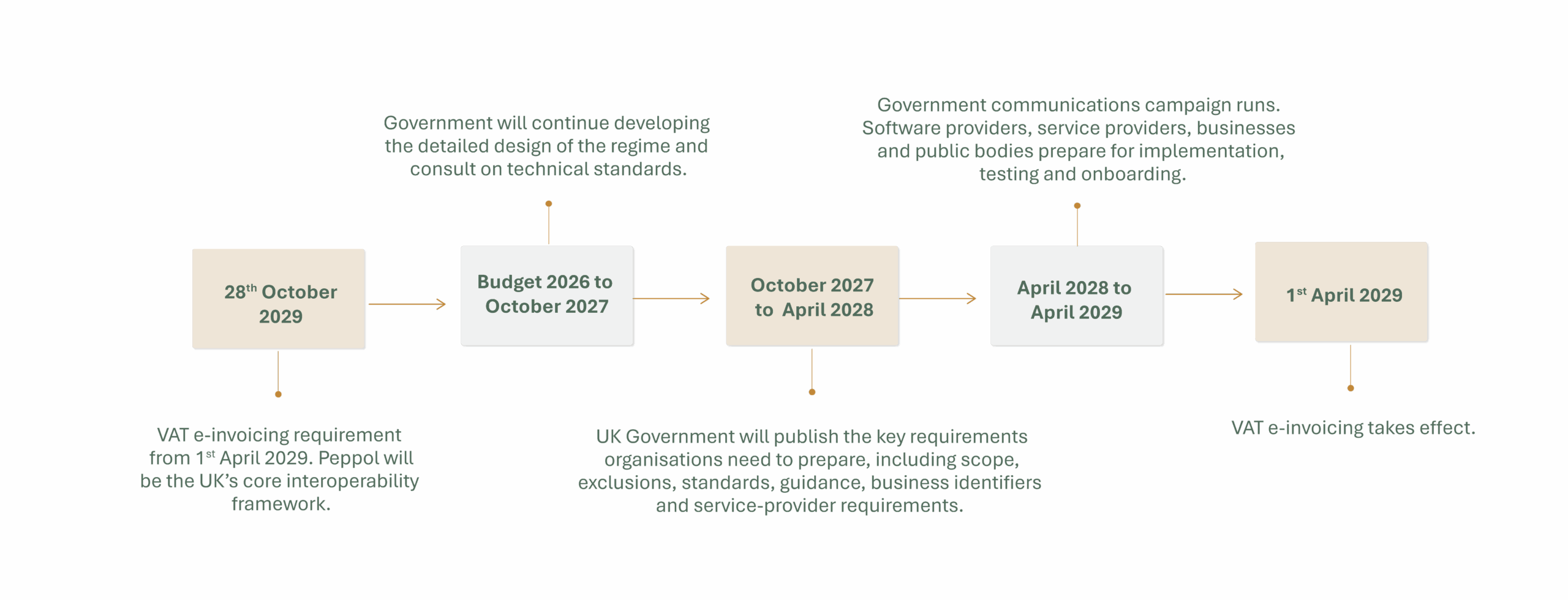
In order to prepare for the upcoming mandate, the UK government has recommended the following steps at this stage:
We are closely monitoring these developments and will continue to keep you informed about their practical implications and the steps organisations can take to prepare.
To read the full Roadmap for e-invoicing implementation on the GOV.UK website, please click here.
For regular updates, please click here to follow us in LinkedIn.
| Cookie | Duration | Description |
|---|---|---|
| cookielawinfo-checkbox-analytics | 11 months | This cookie is set by GDPR Cookie Consent plugin. The cookie is used to store the user consent for the cookies in the category "Analytics". |
| cookielawinfo-checkbox-functional | 11 months | The cookie is set by GDPR cookie consent to record the user consent for the cookies in the category "Functional". |
| cookielawinfo-checkbox-necessary | 11 months | This cookie is set by GDPR Cookie Consent plugin. The cookies is used to store the user consent for the cookies in the category "Necessary". |
| cookielawinfo-checkbox-others | 11 months | This cookie is set by GDPR Cookie Consent plugin. The cookie is used to store the user consent for the cookies in the category "Other. |
| cookielawinfo-checkbox-performance | 11 months | This cookie is set by GDPR Cookie Consent plugin. The cookie is used to store the user consent for the cookies in the category "Performance". |
| viewed_cookie_policy | 11 months | The cookie is set by the GDPR Cookie Consent plugin and is used to store whether or not user has consented to the use of cookies. It does not store any personal data. |